
Go to pretty much any Indian restaurant outside the country and you’ll see it — naan, tikka masala, tandoori everything. That’s North Indian food’s global ambassador duty, and it’s done the job well. Too well, maybe. Because reducing an entire region’s cooking to butter and cream is a bit like saying South Indian food is just dosa. It misses almost everything interesting.
Here’s the thing about North India: it’s brutal in the summer, freezing in winter, and for centuries it sat at a crossroads where traders, invaders, and travelers all stopped, stayed, and cooked. What came out of that mix is food meant to get people through hard months — not dainty, not delicate. Hearty. Communal. Built for a table, not a single plate.
Getting to the Roots of North Indian Cooking
Down south, it’s rice country, coconut country — tropical, wet, quick-cooking. Up north, it’s wheat. It’s milk. It’s beans and lentils simmered for hours until they turn into something else entirely. Everything tastes like it took time, because it did.
The Real Engine Room: Bhuna
South Indian cooking wakes the oil up with a sharp crackle of mustard seed. North Indian cooking does something slower. It’s called bhuna, and it’s basically patience turned into a cooking method: onions, garlic, ginger, tomato, all cooked down in ghee until the water’s gone and the fat splits clean from the paste. That dark, reduced, almost sticky base? That’s the actual engine behind most northern curries. Skip it, rush it, and the curry just tastes flat — thin, missing something.
Three Spices That Do the Heavy Lifting
People assume North Indian heat comes from chili. Mostly it doesn’t. It comes from warmer, rounder spices — toasted cumin, coriander, a garam masala blend with cardamom, cinnamon, clove, nutmeg, black pepper. These aren’t sprinkled on top like an afterthought. They cook into the gravy, low and slow, so the heat creeps up on you instead of announcing itself.
A Region, Not a Single Cuisine
Calling North India “one cuisine” is honestly a stretch. The food changes completely as you move from the mountains toward the plains.
1.Punjab: Tandoors, Ghee, and Grain
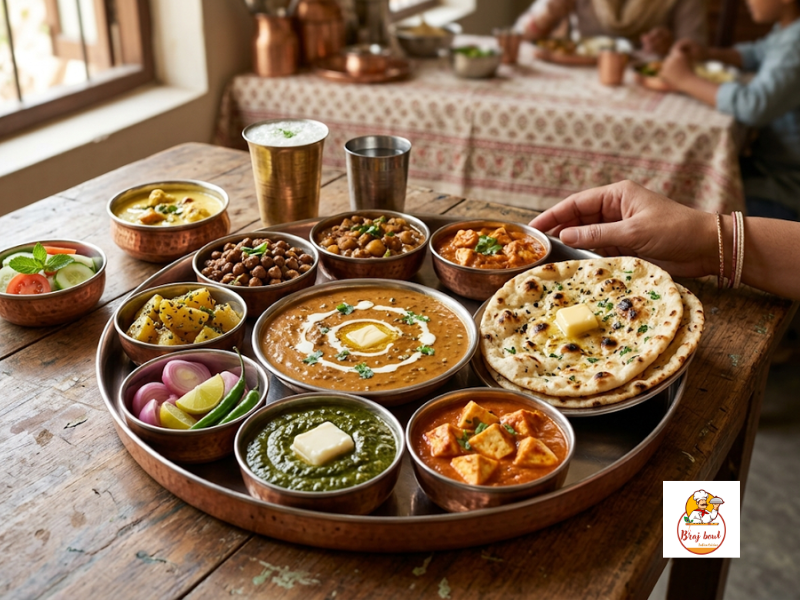
Everyone credits Punjab with putting Indian food on the world map, but the actual home cooking looks nothing like the restaurant spread. It’s plainer. Sturdier. Built for cold weather. People pair Sarson Ka Saag—a slow-simmered mash of mustard greens and spinach—with makki ki roti (a cornmeal flatbread) and a generous smear of homemade white butter. And Dal Makhani — people think it’s a cream dish, but traditionally? Not really. Black lentils and kidney beans cook over charcoal for something like twelve hours. That’s what makes it silky. Not a splash of cream stirred in at the end.
2.Delhi and Uttar Pradesh: Where Mughal Refinement Meets Street Chaos
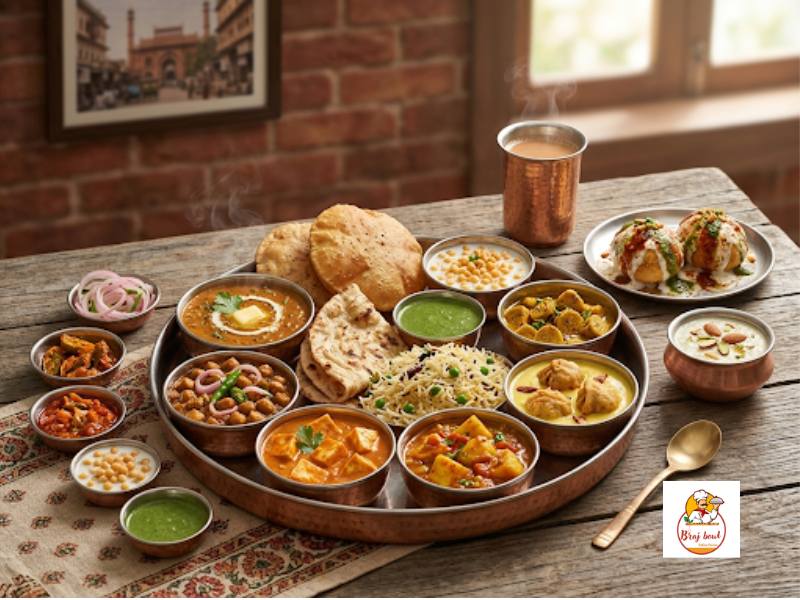
Two completely different food cultures stacked on top of each other here — the refined, perfumed cooking from Mughal royal kitchens, and then, a few streets over, loud, fast street food that doesn’t care about elegance at all. The tandoor bridges both worlds, turning out smoky naan and khamiri roti with real char.
Korma and nihari lean on yogurt, cashew paste, kewra water, saffron — soft, rounded flavors. Then you’ve got aloo tikki: crispy potato patties drowned in tamarind chutney and mint, loud and tangy, nothing subtle about it.
3.Rajasthan: Cooking for the Desert
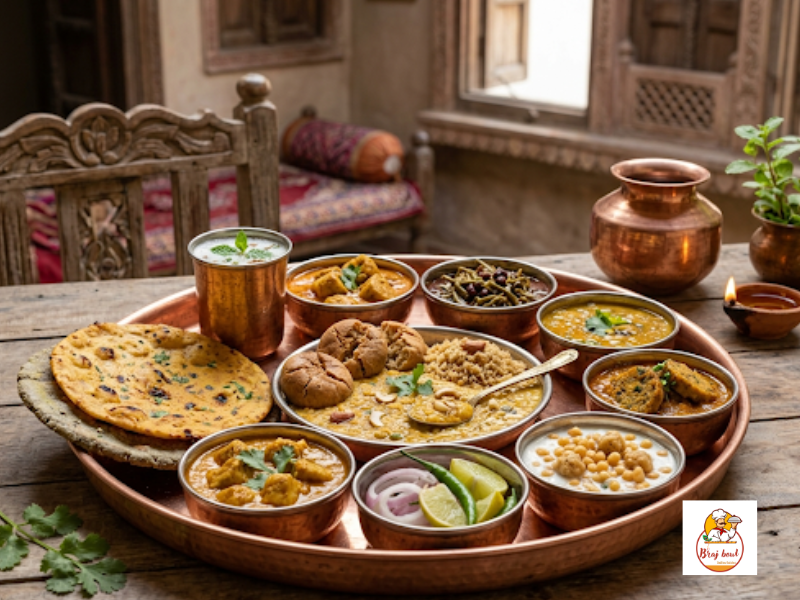
This is desert cooking, plain and simple — no easy access to fresh vegetables or water historically, so cooks worked with milk, buttermilk, ghee, and tough local ingredients like ker sangri (a wild desert bean). Laal maas is the dish everyone knows: mutton cooked in Mathania chilies, yogurt, garlic — properly fiery, no apologies. Sometimes finished by dropping a live coal straight into the pot right before serving. That smoky hit is deliberate.
4.Jammu and Kashmir: Aromatic and Restrained
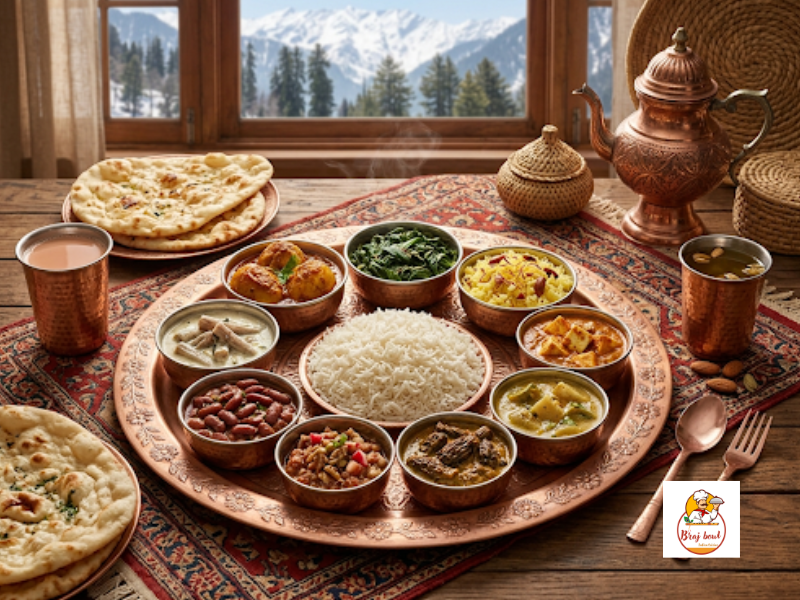
Completely different register up in the mountains. Kashmiri cooking mostly skips the onion-garlic base that dominates everywhere else in the North, leaning on aroma instead. Two traditions run side by side — Pandit cooking (asafoetida, yogurt) and the elaborate Wazwan banquet, reserved for big occasions. Rogan Josh is the famous one: lamb, deep red from Kashmiri chilies (color, not much heat), with fennel and dried ginger doing the aromatic work. Basmati rice instead of bread, mostly.
Understanding the North Indian Thali
A proper North Indian feast lands on a large steel or brass platter known as a thali — and it’s less a meal than an entire spread, engineered to hit every texture and flavor in one sitting.
Eating a thali is meant to be hands-on. Tear off a piece of warm roti or paratha with your right hand and use it to scoop up dry vegetable dishes like aloo gobhi, or a rich paneer or meat curry. Partway through, a spoonful of cool cucumber raita resets your palate. By the end, the last bit of rice gets mixed with a garlicky dal tadka, and that’s usually how the meal wraps up — warm, simple, satisfying.
Questions People Often Ask About North Indian Food (FAQ)
1.Is North Indian food always heavy and oily?
Not even close. Everyday home cooking is quite light — a thin whole-wheat roti, a brothy dal, and a lightly oiled vegetable stir-fry make up a typical meal. The rich, cream-heavy dishes people associate with the cuisine are mostly reserved for weddings and restaurant menus, not daily eating.
2.What actually separates naan from roti?
It comes down to flour and fermentation. Roti (also called chapati) is unleavened, made from whole wheat flour, and cooked on a flat griddle called a tawa, day in and day out. Naan uses refined flour, gets leavened with yeast or yogurt, and is cooked by slapping it against the scorching inner wall of a tandoor — which gives it that signature chew and stretch.
3.Is meat the main focus of North Indian cuisine?
That idea mostly comes from restaurant menus abroad. Meat dishes like kebabs and kormas are certainly part of the picture, but states such as Rajasthan, Punjab, and Uttar Pradesh have enormous vegetarian populations. Dishes built around paneer, chickpeas, kidney beans, and seasonal greens are just as central, if not more so.
4.Why does paneer show up so often?
The North is a major dairy-producing region, so paneer — a fresh, unaged cheese — became the go-to protein for vegetarian cooking. Since it doesn’t melt, it soaks up whatever it’s cooked in, whether that’s a spiced tomato gravy, a buttery onion base, or a spinach curry.
5.Why does North Indian food feel less spicy than South Indian food?
The heat in northern cooking usually comes wrapped in sweeter spices — cinnamon, cardamom, cumin — plus dairy like yogurt, cream, and butter, all of which soften the sharpness of raw chili. The result is a heat that lingers and builds rather than hits all at once, unlike the sharper, more immediate spice found in southern dishes.
6.What’s the deal with tandoors?
A tandoor is a cylindrical clay oven, often set into the ground or housed in an insulated shell, fired by charcoal or wood underneath. Internal temperatures can climb past 480°C. Cooking in that kind of heat locks moisture into meats instantly and gives breads their distinctive smoky flavor and char — something almost impossible to replicate any other way.