
Here’s the backstory: Rajasthan sits mostly in the Thar Desert, where water was never something you could take for granted and green vegetables barely grew at all. So cooks did what smart cooks always do — they worked with what they had. Grains, lentils, buttermilk, ghee, and spices strong enough to leave an impression. The food that came out of this isn’t a compromise or a workaround. It’s genuinely one of India’s richest regional cuisines, and it holds up on its own merits.
Why Does Rajasthani Food Taste So Different?
You can’t separate this cuisine from the desert it came from. Cooking here had rules, and those rules came straight from the climate.
Take dairy, for starters:
Milk, curd, buttermilk, ghee — these show up constantly, often doing the job water would do elsewhere. Besides adding richness, they help food stay edible for days, which mattered a lot before refrigerators existed.
Then there’s the whole approach to ingredients:
Instead of leafy greens (which just don’t survive out there), kitchens leaned on dried lentils, sun-dried berries, and papad. Preserved, not fresh — but far from boring.
And the spices?:
Red chili, garlic, coriander, cumin — used with a heavy hand. Not just for flavor either. In brutal heat, these spices actually help with digestion, so their role goes beyond taste.
Put it all together and you get food that shows up in two very different settings: grand royal spreads fit for a Maharaja, and simple meals cooked over a fire in someone’s courtyard. Same ingredients, same philosophy, wildly different occasions.
The Dishes That Define Rajasthan
If you only have time to try a handful of things, make it these. They’re the dishes locals will mention before you’ve even finished asking.
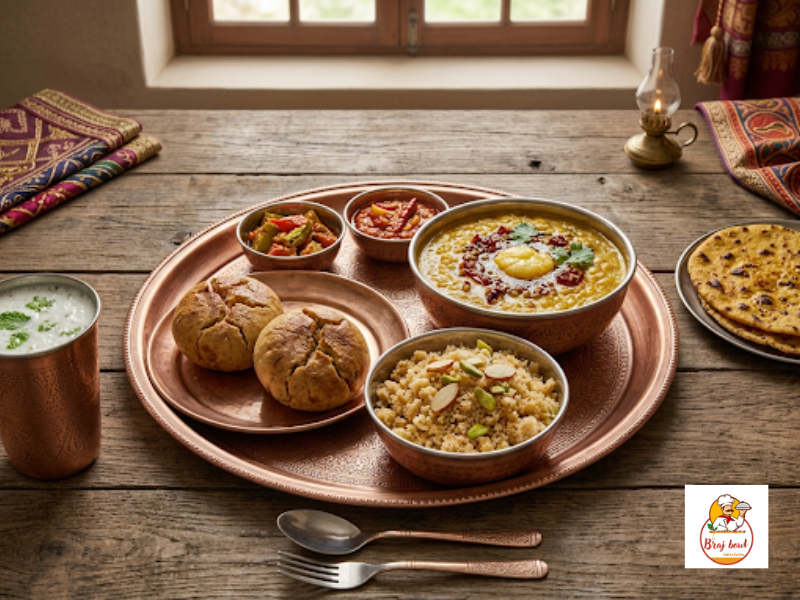
1.Dal Baati Churma — Where It All Starts
You can’t talk about Rajasthani food without landing here first. This isn’t really one dish — it’s three, served together, and somehow they work as a single experience.
The baati is a hard wheat flour ball, baked over coals until firm, then cracked open and soaked generously in ghee. The dal brings the savory element — a curry made from a mix of five lentils, known as Panchmel Dal, spiced just right. And the churma? That’s crumbled baked wheat dough mixed with jaggery or sugar, cardamom, and a scattering of nuts.
Eat them together and you get salt, fat, and sweetness all landing in the same bite. It sounds like a lot. It is a lot. It’s also completely worth it.
2.Ker Sangri — Desert Ingenuity, Plated
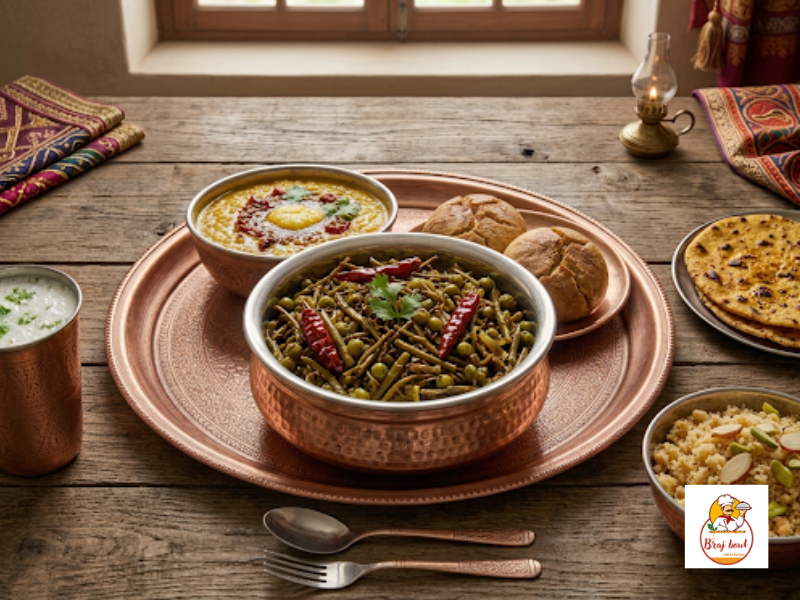
If Dal Baati Churma is the crowd-pleaser, Ker Sangri is the dish that tells you something real about desert survival. It’s made from ker (dried wild berries) and sangri (long green beans), both native to this exact region and nowhere else, really.
Cooked with mustard oil, a mix of spices, and a hit of dry mango powder for tang, this dish kept people fed through some genuinely brutal drought years. Today it’s less about survival and more about flavor — sharp, a little sour, deeply satisfying alongside a hot bajra roti.
3.Rajasthani Kadhi — Comfort in a Bowl
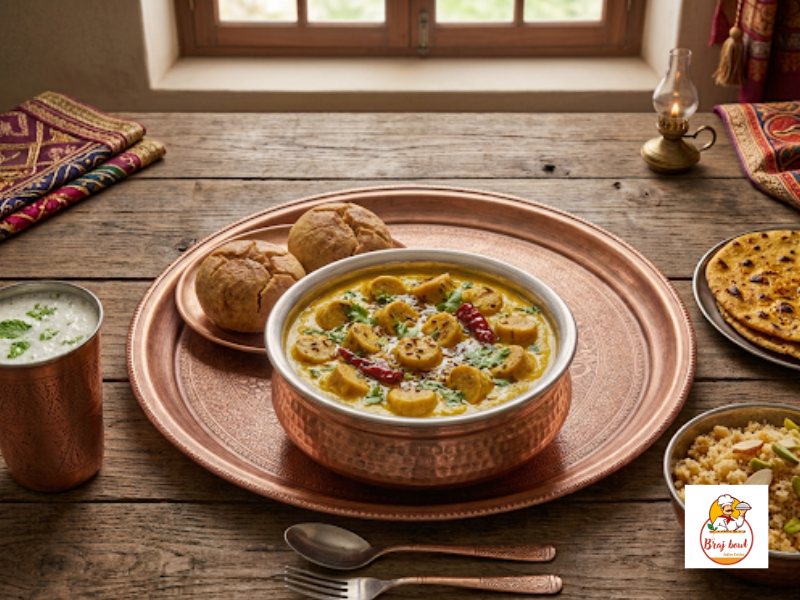
This one doesn’t get the same spotlight as the others, but ask anyone from the region and they’ll tell you it deserves to. Made from besan and buttermilk, simmered slowly with mustard seeds, curry leaves, and a touch of jaggery for balance, it’s tangy, warm, and exactly the kind of thing you want on a cold evening. Simple ingredients, but the technique — getting that buttermilk to cook down without curdling — takes real skill.
4.Gatte Ki Sabzi — Besan, Reinvented
Fresh vegetables were scarce, so gram flour stepped in as the hero ingredient. For this dish, seasoned besan dough gets shaped into logs, boiled, sliced into bite-sized pieces, then simmered in a spiced yogurt gravy until everything comes together. It’s humble, it’s everywhere in Rajasthani homes, and honestly, it’s a masterclass in turning almost nothing into something genuinely good.
5.Pyaaz Kachori — Jodhpur’s Street Food Icon
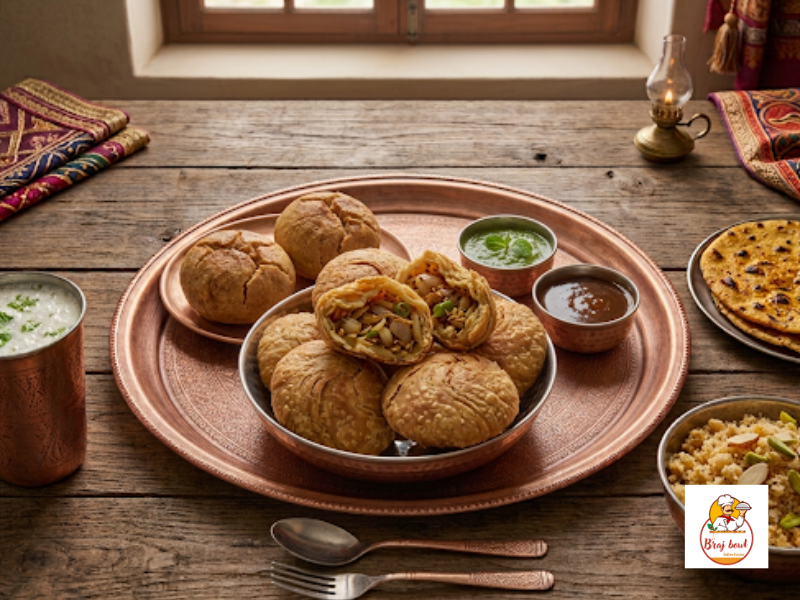
Head to Jodhpur and you’ll smell this before you see it. A crisp, deep-fried pastry stuffed with spiced onion and potato, usually handed to you hot with tamarind chutney on one side and green chutney on the other. It works as breakfast. It works as an evening snack. Honestly, it works any time you’re hungry.
Breads and Sweets Worth Knowing
Rajasthani bread isn’t just wheat roti — millet takes center stage, especially in winter.
Bajra Roti is thick, hand-shaped, made from pearl millet, and traditionally served with fresh white butter and raw onion on the side.
Missi Roti mixes gram flour with wheat flour and a pinch of ajwain, giving it a flavor you won’t find in a plain roti.
As for sweets :
In Rajasthan, they’re not an afterthought tacked onto the end of a meal. They’re often eaten right alongside everything else.
Ghevar is a disc-shaped sweet made from flour and ghee, soaked in sugar syrup and topped with rabri and nuts. You’ll see it everywhere during monsoon festivals.
Mohanthal is dense and fudge-like, built from roasted besan, ghee, and sugar, with saffron and cardamom doing the heavy lifting on flavor.
Mawa Kachori, a Jodhpur specialty, is a flaky pastry stuffed with sweetened milk solids and dry fruits, then dipped in sugar syrup for good measure.
Questions People Actually Ask (FAQ)
1.What do people in Rajasthan eat day to day?
Millet, wheat, gram flour, and a rotating cast of lentils, almost always paired with ghee and some form of dairy.
2.Is Rajasthani food mostly vegetarian?
Yes, overwhelmingly. Marwari and Jain traditions shaped much of the state’s cooking, which is why vegetarian dishes dominate the cuisine so heavily.
3.Why so much ghee?
A few reasons, really. It helped food last longer in extreme heat, gave people the calories they needed for hard physical labor, and made up for the richness that fresh vegetables would’ve otherwise provided.
4.What should a first-timer order?
Start with a full thali — Dal Baati Churma, Gatte Ki Sabzi, Ker Sangri, and a hot bajra roti on the side. That’s about as complete an introduction as you’ll get.
5.Is “Baati” the same thing as “Bati”?
Yes, just a spelling difference. Same baked wheat rolls, same dal, same ghee.
6.Is the food actually that spicy?
Less than people expect, honestly. It’s built more around depth and aroma than raw heat — yogurt shows up a lot precisely to keep things balanced.
Wrapping Up
Rajasthani food isn’t really about following a recipe — it’s about what happens when people refuse to let a harsh landscape dictate a boring diet. Every dish here, from a festive plate of Dal Baati Churma to a quiet bowl of kadhi on a Tuesday evening, carries a bit of that history with it. Whether you’re chasing something sweet like Ghevar or craving something heartier, this is a cuisine that rewards curiosity — and honestly, it’s one of the better reasons to visit the state in the first place.